
US-Iran ceasefire collapses after Strait of Hormuz attacks, sending Brent toward US$79 (Rystad Energy)
Published by Elizabeth Corner,
Senior Editor
Oilfield Technology,
Tensions between the US and Iran have escalated sharply after reported attacks on commercial vessels transiting the Strait of Hormuz. Here is Rystad Energy’s market update from Jorge Leon, Head of Geopolitical Analysis:
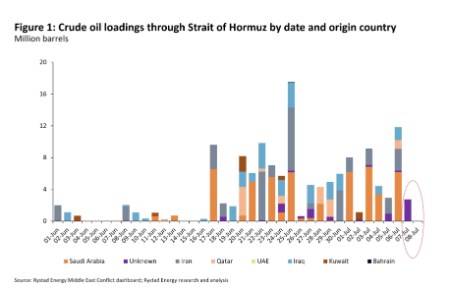
“Tanker traffic through the Strait of Hormuz has essentially stopped, which tells you more about risk perception right now than any statement from Washington or Tehran.
Brent's climb to its highest level since 19 June shows how quickly the market is pricing in a ceasefire the US president himself says is over.
The real test comes after 9 July, once the mourning period ends and both sides show whether there is still an appetite for a diplomatic off-ramp.”
The Strait of Hormuz ceasefire looks to be over, with reported attacks on commercial vessels triggering a new round of US retaliatory strikes overnight, and President Trump himself declaring the truce ended. It’s unclear whether diplomatic channels remain open in practice; the latest military exchanges raise the risk that talks will either stall or continue under much more fragile conditions.
Fundamentally, the events of the last few days significantly weaken any confidence that the current 60-day truce can still evolve into a permanent peace agreement.
Oil markets reacted quickly to the renewed geopolitical risk, with Brent crude climbing to close to US$79/bbl – its highest level since 19 June.
The move highlights how sensitive prices remain to any escalation around the Strait, given its role as a critical transit route for global oil flows.
Even if no sustained physical disruption materialises, uncertainty around vessel safety, insurance costs, potential delays, and the risk of further retaliation is likely to keep volatility elevated in the near term.
Traffic through the strait will almost certainly remain reduced until the security situation becomes clearer and market participants gain more visibility on whether a diplomatic off-ramp remains available. Vessel movements have already fallen sharply, from around 20 vessels on 6 July to just 11 the following day, while traffic so far today appears to be completely halted.
After the burial ceremony of Supreme Leader Ayatollah Ali Khamenei – killed by an Israeli strike at the outset of the conflict – ends on 9 July, both sides could adopt an even harder stance, driving a further uptick in geopolitical risk premiums.
This would be amplified by the summer peak season for road and aviation fuels, when demand-side sensitivity to supply disruption is already elevated.
Read the article online at: https://www.oilfieldtechnology.com/special-reports/08072026/us-iran-ceasefire-collapses-after-strait-of-hormuz-attacks-sending-brent-toward-us79-rystad-energy/
You might also like
Energy-importing countries scaling clean energy three times faster than exporters
Energy-importing countries are scaling clean energy three times faster than exporters, as governments seek to reduce reliance on imported oil and gas by expanding domestically produced power, according to the tenth edition of DNV’s Energy Transition Outlook.