
Triple-digit oil: Temporary spike or a new market reality? Rystad Energy reports
Published by Elizabeth Corner,
Senior Editor
Oilfield Technology,
Here is Rystad Energy’s oil market update from Janiv Shah, Vice President, Oil Markets, Rystad Energy:
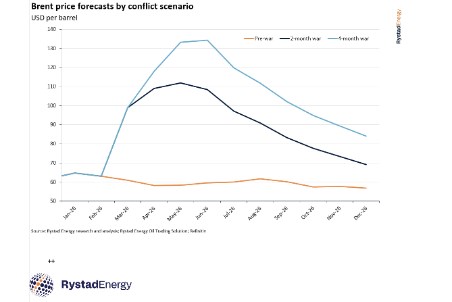
“Brent oil prices could reach US$135/bbl if the current situation persists for four months. The forward-looking analysis we’ve done on a two-month basis is also showing prices stay above US$110/bbl, given the current conditions.
“The market is currently grappling with physical supply being choked off by drone strikes, while Middle Eastern producers are simultaneously hitting a critical point where they must shut in production simply because there is nowhere left to put the oil.
“Russian supply remains the ultimate wildcard in this equation; as prices climb, the incentive to reroute that crude through alternative channels like India becomes impossible for the West to ignore, as evidenced by the recent 30 day US waiver.
“However, these are temporary bandages on a deep wound.
“Between the potential for massive Strategic Petroleum Reserve (SPR) releases and the eventual response from US shale, the world is searching for a stabiliser to absorb this shock.
“With refineries already curtailing throughput as a defensive measure, the focus has shifted entirely from profit margins to national energy security, making current oil prices a very tangible threat to global stability."
Brent spiked to US$116.50 at market open before rebounding to US$104.50 on news of the G7 releasing barrels, however the gain represents an almost 45% increase since the start of the conflict.
This has materially altered our base case market assessment, which was published two weeks before the conflict began.
Under the pre-war scenario, we had expected Brent to average US$60/bbl in 2026, as the market faced a substantial surplus of 2.6 million bpd.
Given the high level of uncertainty surrounding both the duration and the geopolitical trajectory of the crisis, we have developed two alternative scenarios that we currently consider plausible as of 9 March:
- Two-month war scenario: The conflict lasts roughly two months, with the Strait of Hormuz gradually reopening to oil flows by the end of March.
- Four-month war scenario: The conflict extends to four months, with Hormuz reopening more gradually by the end of April.
Both scenarios rely on several underlying assumptions that may change rapidly as events evolve.
At present, the two-month scenario appears more likely, although the situation remains highly fluid.
More extreme scenarios cannot be ruled out right now.
Under the two-month scenario, Brent prices rise to above US$110/bbl in April before gradually declining as supply flows normalise, reaching US$70/bbl by year-end.
The resulting 2026 average price would be approximately US$87/bbl.
In the four-month war scenario, the longer disruption leads to a sharper price spike, with Brent reaching around US$135/bbl by May before easing to US$85/bbl by the end of the year as market balances begin to normalise.
The resulting 2026 average price would be approximately US$100/bbl.
Read the article online at: https://www.oilfieldtechnology.com/special-reports/09032026/triple-digit-oil-temporary-spike-or-a-new-market-reality-rystad-energy-reports/