
Seadrill launches safety technology for offshore drilling
Published by Naomi Holliman,
Digital Editorial Assistant
Oilfield Technology,
Seadrill Limited has announced the introduction of Vision IQ for offshore drilling rigs, a next-generation AI-enabled safety technology, which monitors and provides advanced warning of potential risks in the ‘Red Zone’. The Red Zone is the area of the rig floor where heavy drilling equipment operates and the risk of injury is highest. Seadrill plans to make the technology behind Vision IQ available to peers as part of its commitment to driving safety in the industry.
A safety system, Vision IQ, combines artificial intelligence (AI), Laser Imaging, Detection and Ranging (LiDAR) and advanced edge computing technology to ensure safer and more efficient operations in the Red Zone for all Seadrill’s offshore rigs and drillships. Comparable to the use in autonomous vehicles, LiDAR technology surrounds the Red Zone of the rig to create a dynamically monitored environment, while Vision IQ’s advanced AI technology allows real time monitoring of the Red Zone using 3D visualisations.
This holistic view enables users to pinpoint the exact position of crew members on the rig floor in relation to moving heavy equipment and provide advanced warning of potential hazards, thereby limiting scope for human error. Vision IQ is engineered for offshore drilling and can be integrated into the rig’s anti-collision system (ACS), creating a more unified approach to safety.
The introduction of Vision IQ is a significant step forward in improving offshore worker’s safety. For this reason, Seadrill has committed to voluntarily share the technology behind Vision IQ with its peers in the industry.
Read the article online at: https://www.oilfieldtechnology.com/digital-oilfield/20082019/seadrill-launches-safety-technology-for-offshore-drilling/
You might also like
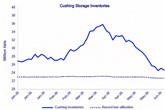
Cushing crude stocks sit less than 2 million bbls above operational floor amid global supply crisis
Cushing crude storage levels have plummeted in recent months. Inventories fell 11.3 million bbls to less than 25 million bbls between early April and early June, according to Wood Mackenzie.